Pick up any wedding checklist and it will tell you to book the venue twelve months out, send invitations eight weeks before, and confirm the timeline with your vendors the week of. Useful, if your wedding is one day. Less useful if it starts with a welcome dinner on Friday, has a mehendi on Saturday afternoon and a ceremony on Sunday, at three different places.
A wedding with more than one event isn't one wedding with extras. Each event is its own small production: its own venue, its own food, its own guest count, its own schedule and its own vendors. The work multiplies, and so do the deadlines, because each event's deadlines count back from its own day, not from the wedding day.
Here's how we think about it.
Start with the list of events, not the list of tasks
Before you write a single to-do, write down every event you're actually having, with a date for each. Welcome dinner, haldi, mehendi, sangeet, rehearsal dinner, nikah, tea ceremony, the wedding day, a brunch the morning after. Whatever yours are.
This sounds obvious. It isn't how most couples start. Most start from a generic list, then bolt the extra events on later, which is how the mehendi artist gets booked four weeks out instead of six months out.
Once the events are written down, every event needs the same four things, each counted back from that event's own day:
- A venue, about eight months before.
- A menu, about four months before.
- What you'll wear, about three months before.
- A schedule for the day, about a month before.
That's four to-dos per event before you've thought about anything specific to it. Three events, twelve to-dos. Five events, twenty.
Then add what each event needs of its own
Every tradition and every kind of gathering brings its own work. A few examples, with roughly how far ahead each one wants doing:
A welcome dinner needs its invitations out about three months before, transport between the dinner and the hotel booked about two months before, and a final headcount to the restaurant about three weeks before.
A mehendi needs the artist booked early, around six months out, because good ones are booked for whole seasons. Then the music and dhol about four months out, the favours and the decor about three, and the henna designs chosen about two months before.
A sangeet needs its DJ or band and its choreographer about five months out, the performances planned about three months out, and the dance rehearsals in the last two weeks.
A rehearsal dinner needs the ceremony rehearsal booked and the wedding party invited about two months before, and the toasts planned in the last couple of weeks.
A nikah needs its officiant about six months out, then the decor and the readings and recitations.
A tea ceremony needs the tea set, a list of the family members you'll serve, and the tea and sweets ordered in the last couple of weeks.
None of this is exotic. It's just work that a one-day checklist never mentions, and it all lands in the same months as the wedding day's own to-dos.
Date everything from its own day
The mistake we see most often is dating every task from the wedding day. If the welcome dinner is two days before the ceremony, that doesn't matter much. If the mehendi is a week earlier, at the family home in another city, it matters a lot: "book the mehendi artist six months before the wedding" quietly becomes five and three-quarter months before the mehendi.
So anchor each event's to-dos to that event's date, and the whole-wedding to-dos (the budget, the guest list, the photographer) to the main day.
When a date moves, move the to-dos with it
Dates move. The venue offers you a better weekend, a relative can't travel in March, the mehendi shifts to the morning after the welcome dinner. When that happens, every to-do still to do for that event needs a new date, and a list on paper or in a spreadsheet won't do that for you.
The rule we use: when an event's date moves, the open to-dos for that event move with it, by the same rule they were made with. To-dos you've already ticked stay ticked. A date you set by hand stays where you put it, because you set it for a reason. And nothing is ever moved into the past: if you start late, a to-do that should have happened already is due today, not overdue the moment you add it.
Keep it to one list
The other thing that goes wrong with several events is several lists. A note for the mehendi, a spreadsheet for the wedding day, a group chat for the welcome dinner. Then the question "what's due this week?" has three answers, or none.
One list, grouped by month, with the overdue ones on top and each to-do knowing which event it belongs to, answers it. You can still look at one event at a time when you need to. You just never have to merge three lists in your head.
How we built it
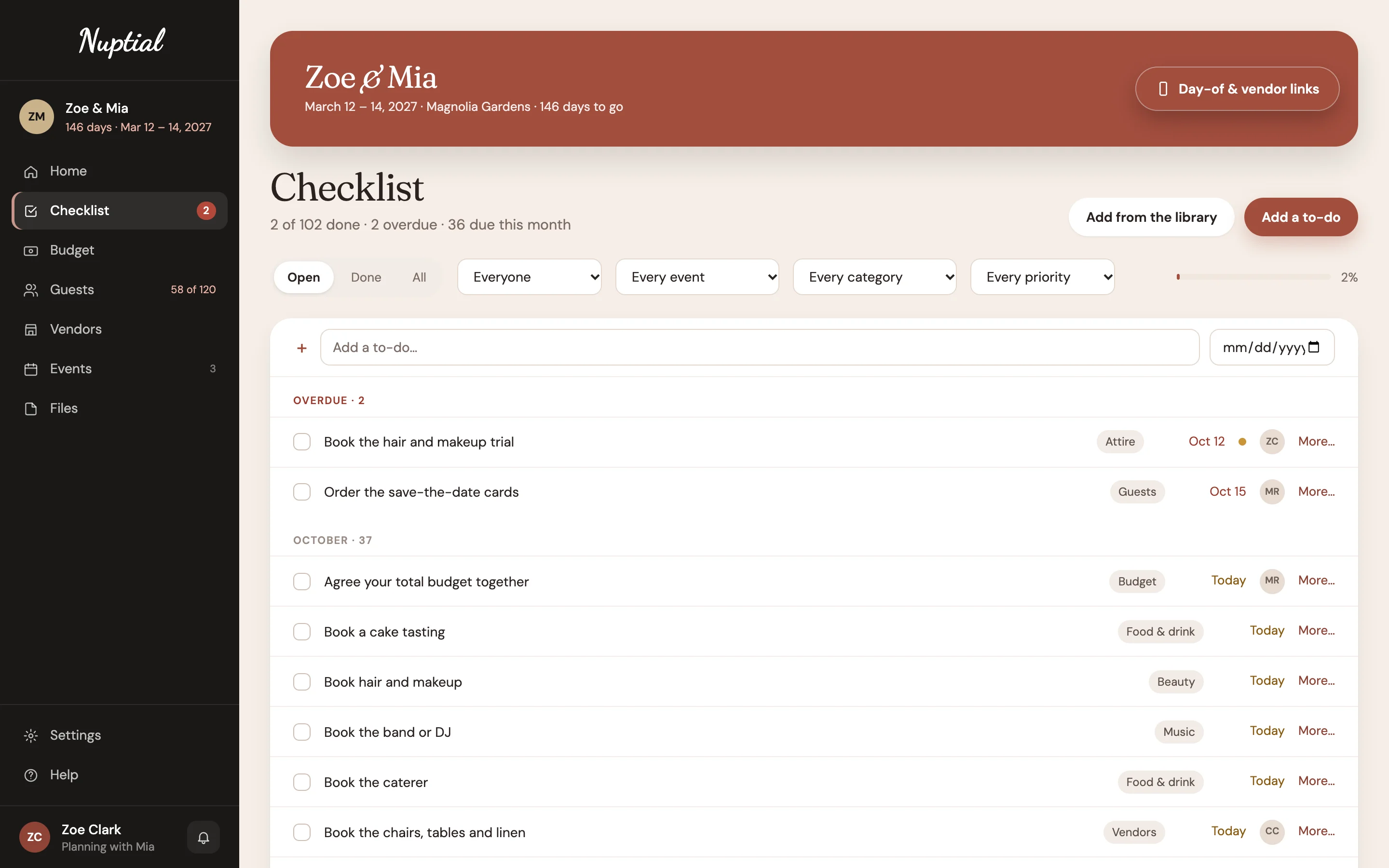
This is how the checklist in Nuptial for Couples works. You tell it your date and the events you're having, and it builds the to-dos for each event from its own day: a venue, a menu, what to wear and a schedule for each event around the wedding day, plus the ones its tradition brings. Move an event's date and its open to-dos follow. Take on something new later and you can add it from the library, or write your own. Hand a to-do to your partner and it carries their name.
The checklist is free, with no card and no trial clock, and your partner signs in too. The budget, vendors, guests and a schedule for every event are there when you want them: here's what the planning tools add.
If your wedding is more than one day, this is the part to get right first. Everything else hangs off the dates.